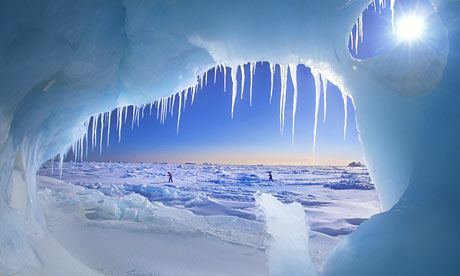
For my first ten cool facts about ice, visit this post. And now, on to six more!
1. There are a couple of places in the world-- Quebec City and Jukasjaarvi, Sweden among them, where you can stay in a hotel made of ice. These hotels are a little fancier than the ice castle occupied overnight by the Diva in my novel The Ice Castle.
My sister-in-law has stayed in an ice hotel and slept in an ice bed. Her verdict? "It was cold."
2. Carbon dioxide exists in liquid form only at high pressure, above 5 atmospheres. This is the pressure you would feel 132 feet below the ocean surface.
 3. How to make dry ice: Take a carbon dioxide-rich mixture of gases, and pressurize it until it turns to liquid. Then release the pressure. This allows some of the liquid to vaporize, which cools the remaining carbon dioxide liquid enough to transform it into the solid known as dry ice.
4. Dry ice, as it sublimates (vaporizes), can attract mosquitoes or bedbugs, which are drawn to carbon dioxide. How about a dry ice mosquito trap? Or placing an open thermos of dry ice beside that old couch your friend is lending you, before you lie down?

5. Mars has polar snowstorms of dry ice snowflakes. The snowflakes are very small, about the size of human red blood cells. Paul Doherty showed that carbon dioxide snowflakes will not have the beautiful crystalline structure of H2O snowflakes. Instead, they'll be cubes, octahedrons, and cuboctahedrons, which are basically cubes with the corners sawed off. For more about dry ice on Mars, read Paul Doherty's blog post on the topic.

 6. If all the floating sea ice of the Arctic melted, how much would sea level rise? Not at all. Floating ice already displaces the same volume of water it would occupy if it melted into water. For the same reason, the water level in a glass filled with water and floating ice will not rise as the ice melts. (If the ice cubes are packed in to the glass and not actually floating, the result may be different.)
 Note, however, that if all the sea ice of the Arctic melted, that would reflect a warming of the oceans. Warmer water expands, so we would sea some sea level rise - not because of the melting, but because of the expansion that comes with warming.