Showing posts with label science. Show all posts

Tuesday, September 18, 2012

Diamonds: ten scintillating facts


   1.   Diamonds were first mined in India 3000 to 6000 years ago.

   2.    The name “diamond” comes from a Greek word meaning “unbreakable.”  Another word from the same root is “adamant,” meaning either incredibly hard or utterly unyielding in attitude or opinion.

   3.    Diamonds are a cubic crystal of pure carbon – the same material as coal or the “lead” (really graphite) in pencils.

   4.   Because diamond is made of carbon, combusting it with heat and oxygen leads to the production of carbon dioxide gas, as first demonstrated by chemist Antoine Lavoisier in 1772. Lavoisier used lenses to concentrate heat of the sun on a diamond surface until it began to vaporize.
 
   5.    Just one stray atom in a million can give a diamond a distinctive color.  If the stray atoms are boron, the diamond will be bluish; if nitrogen, it will be a faint yellow.

   6.     In 2011, the recently discovered Cora Sun-Drop, a 110-carat yellow pear-shaped diamond, sold at auction for $10.9 million.

   7. Not only is diamond the hardest naturally occurring substance, it’s also the best thermal conductor.  That is, it will transfer heat from one place to another 
      much better than any metal.

   8.   Every year, 33,000 kilograms of diamonds are mined, while another 110,000 kilograms of diamond are manufactured synthetically. Only 20 percent of mined diamonds are large and pure enough to be gem grade.

   9.  Cutting a diamond to make a gem generally removes about half the weight of the diamond.

  10.  Most earthly diamond was created 1 to 3 billion years ago in the pressure and heat of the mantle around 100 miles under the earth’s crust.  Diamond comes to the surface in volcanic events as magma rises through the crust.

To learn more about diamonds, check out Mae and Clinton’s adventures in my scientific mystery for kids, The Desperate Case of the Diamond Chip. 

Wednesday, August 22, 2012

Dry ice and water ice - ten cool facts


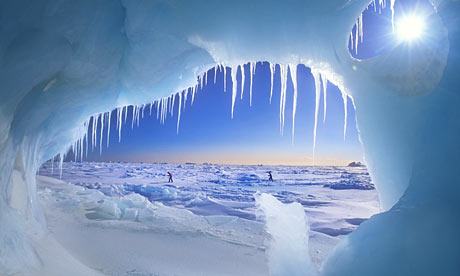
Interested in ice?  In honor of the publication of The Ice Castle, an Adventure in Music, here are 10 random facts about ice.

1)  Regular ice is frozen water.  Dry ice is frozen carbon dioxide, and it’s very cold, below -78 degrees Celsius.  Unlike water, carbon dioxide does not go though a liquid stage as it cools from a gas stage to a solid stage.  Similarly, dry ice doesn’t melt.  Instead, it changes directly from solid into a vapor or gaseous form. This change is called sublimation.

2)  Ice covers about 10 percent of the Earth’s land mass and about 7 percent of its oceans.

3)  Water is one of very few compounds in the universe that expands as it cools from liquid to solid form.  That’s why ice floats on water.  It’s also why a closed bottle of water, left out in the freezing cold, can push its top off or even burst.

4)  The reason ice looks cloudy is because of tiny air bubbles trapped in the water as it freezes.  You can actually get clearer ice cubes by starting off with warm or hot water, which has less dissolved air in it than cool water coming straight from a frothy faucet.

5) The water at the bottom of the deepest oceans is actually -4 degrees Celsius.  Why is it still liquid when it’s below freezing?  Remember, water has to expand to form ice. The water at the bottom of the ocean, crushed under all that water pressure, can’t expand to form ice crystals, even though it’s very cold.

6) Dry ice sinks in water.  Its specific gravity (density compared to water) is about 1.5.  If you drop it in water, though, you’ll get wild bubbling and an outpouring of what seems to be cold steam.  That’s why dry ice is great to cool your punch at a Halloween party.

7) The ice in comets is not the nice crystalline structure we know.  Instead, it’s an amorphous (without form) random arrangement of molecules known as “glassy ice.”  On earth, glassy ice can only form when water is rapidly cooled to -137C.

8) Sea ice is important to regulating global temperature, because the white, bright ice reflects back 80% of the light that hits it and helps to keep the ocean cool.  Once sea ice melts, the dark-colored ocean absorbs ninety percent of the sunlight, leading to greater warming.

9) Algae grow between the cracks in sea ice and even on the underside of the ice, providing food for tiny shrimp-like krill throughout the dark, cold arctic winter.

10) In the science fiction book Cat’s Cradle by Kurt Vonnegut, ice-nine is a special form of ice crystal that causes any water it comes in contact with to solidify immediately into more ice-nine.  Throwing a tiny piece of ice-nine in the ocean could instantly dry up all the water in the world.

11)  Bonus fact:  In The Ice Castle: An Adventure in Music, Ivan and Daphne are stuck in the Land of Winter, where social status and opportunity are determined solely by how well a person sings.  Spring will come to the Land of Winter only when the Diva sings her way free of a castle built of ice.

For more cool facts on ice, check here.

For facts on diamonds, try here.

And for facts on glass, visit here.

Thursday, August 16, 2012

FutureDude on Venus


Today I'm sharing an interview with Jeffrey Morris, lead author and artist for the new graphic novel Venus: Daedalus One.  Jeffrey has a beautifully illustrated online magazine that celebrates science and exploration, and he's currently running a Kickstarter campaign to help finance the creation of his second planetary graphic novel, Mars: Daedalus Two.
 Jeffrey is a gentle person with a real dedication to kids and the future, and his comics are exciting while still managing to stay free of the sexism and violence that mar so much of this art form.

How do you make a graphic novel? 

We start with a solid story concept with strong visual potential—which in the case of Venus: Daedalus One was a 110-page feature film script. As an illustrator, I also created a dozens of pencil sketches and marker renderings to get a sense of what the world in our story looked like. Many of these were translated into computer generated images that we could fly around and manipulate. All of the aforementioned media served as the basis for a comic artist to begin building the actual panels and pages. I worked hand in hand with him and colorists to bring the full vision of the script to life in comic form.


What's Venus like, and what made you decide to write about it?

I wanted to tell a futuristic story set within our own solar system with a focus on one of the inner planets.  Quite a few books and movies have taken place on Mars, while virtually none have occurred on Venus. I think a primary reason is that Venus is a pretty inhospitable place. Searing heat, crushing pressure and scalding acid are the norm. There is no water and little to no chance of life as we know it. I thought it would be fun to throw a group of conflicted characters into a environment that challenging.


Do you think we'll find life on other planets in our solar system?

Absolutely! It is inevitable and just a matter of time. The key question is whether or not human curiosity can outpace waning public interest, partisan politics, and shrinking science budgets. Eventually, we need human minds, eyes, and hands directly on location throughout the Solar System in order to use our innate instincts and intuition to help us uncover the clues that will lead us to life. However, in the meantime, we should continue to launch a barrage of space probes, like NASA's Curiosity, to every possible destination. They are our emissaries for now.

What are you working on next?

I currently am developing Mars: Daedalus Two and several other realistic science fiction stories. Each is part of an ever-expanding world of hard science-fiction titles. My team and I want to establish a niche for ourselves as the purveyors of visually stunning futuristic media that entertains, educates and never underestimates the intelligence of the audience.

Ten years from now, looking back on your work, what do you hope to see?

I hope to have made a real difference in the average person's perception of tomorrow while energizing a base of individuals to work for a better future. I intend to do this by building several successful hard sci-fi franchises that are able to expand into numerous areas or media and entertainment that can truly withstand the test of time. After all, my stories are envisioning and often predicting the future! 

Saturday, October 29, 2011

Fear of Science

Do Americans fear science? Not just having to study it, but science as an enterprise? The October 26 episode of Jon Stewart's Daily Show gives a hilarious, chilling view of one population segment's attitude toward science. Watch it.

The truth is, a large segment of the American population distrusts scientists and, like the woman in the interview, would rather trust their gut than scientific evidence. It's telling that of all the Republican candidates for president, only one, Jon Huntsman, has spoken up in defense of science. To quote him,
Listen, when you make comments that fly in the face of what 98 out of 100 climate scientists have said, when you call into question the science of evolution, all I'm saying is that, in order for the Republican Party to win, we can't run from science.

Most of the other candidates seem to have decided that running from science is good campaign strategy. Even Mitt Romney, who knows better, has been shifting rightward on the question of climate change. In his 2010 book No Apology, he wrote, "I believe that climate change is occurring. ... I also believe that human activity is a contributing factor." In June, 2011, he said that the US should "reduce our emissions of pollutants and greenhouse gases that may be significant contributors." Now he says, "My view is that we don't know what's causing climate change on this planet. And the idea of spending trillions and trillions of dollars to try to reduce CO2 emissions is not the right course for us." This is not just a change in Romney's preferred policies, it's a stated change in his beliefs -- all of a sudden, even as the scientific consensus becomes clearer and clearer, Romney doesn't know what's causing climate change. He's embraced the campaign strategy of fleeing science.

The point that Jon Stewarts show makes is that some of us distrust science because we think it's something only scientists can understand and evaluate. So who's to say the scientists aren't all ganging up together to fool us and keep grant money coming? This is a new twist on America's bent toward anti-intellectualism. All of a sudden, there's a group of us not ashamed to say, "Look, I'm not educated enough or smart enough to understand this, so I don't trust the people who do."

Come to think of it, that's kind of the way I used to feel about car mechanics. They know about my car, and I don't, so they can tell me I need to buy something, and I don't know how to evaluate the recommendation. Of course, I can always take the car to another mechanic.

What many people don't understand about science is that it's always automatically being taken to another mechanic. That's the process of peer review and of replicating experiments. Sure, there are cases of scientific fraud. But the system uncovers them automatically, without the need for government wiretaps, and a lot faster than it took Bernie Madoff's fraud to unravel and expose itself. Science is a self-correcting way of getting at new knowledge. That's what's wonderful about it. What to do with that knowledge is a legitimate political question. But running away from that knowledge because it feels uncomfortable is succumbing to our most craven instincts. It's sort of like saying, "Well, I know my cholesterol can't be that high because I feel fine." Gut feelings don't prevent heart attacks.

Friday, June 17, 2011

Merchants of Doubt, a book review

Merchants of Doubt by Naomi Oreskes and Erik M. Conway is an important and eye-opening book. Many of us may have a vague, nagging feeling that there's still something wrong with the science on global warming or acid rain, or an idea that Rachel Carson's attack on DDT was somehow sloppy or overly emotional. It turns out that the reason these doubts play on our mind is that a small group of Cold War physicists and their associates have vigorously campaigned to promote these doubts. Tightly argued and copiously referenced, Merchants of Doubt shows how for this group of scientists, opposition to Communism became opposition to environmentalism because of their conviction that environmentalism would lead to socialist attacks on the free market and therefore on freedom itself.

A handful of scientists and a small but powerful network of funders and think tanks, from Phillip Morris to Exxon to the Competitive Enterprise and Cato Institutes, have orchestrated campaigns of doubt against emerging scientific consensus on a series of issues from the harms of smoking (and second hand smoke) to the ineffectiveness of the Strategic Defense Initiative (Star Wars) to depletion of the ozone layer to acid rain to global warming. Oddly, they have even tried belatedly to undermine Rachel Carson's work on the harmfulness of DDT, charging Carson with responsibility for the malaria deaths of a million African children -- ignoring the fact that insect resistance had already undermined the effectiveness of DDT before Carson wrote Silent Spring.

Oreskes and Conway demonstrate the common strategies used by these scientific contrarians. They begin by focusing on questions and controversies within the scientific community. They call for more research before any precipitate action. They meet with journalists and editorial boards and urge them to "report both sides" of an issue even if one side carries the weight of scientific consensus while the other side is supported only by a handful of professional doubters. They write articles for non-peer-reviewed (often industry-sponsored) publications and then quote these reports in the popular press as if they had equal weight with original peer-reviewed research or massive reports of scientific consensus. When necessary, they launch vicious attacks on the personal integrity of scientists they see as representing the wrong side.

This is scary stuff. It's important to read this book carefully, to keep an eye open for evidence of bias or exaggeration by the authors. At times they may state some conclusion a bit too strongly. At times they attribute motives to the sowers of doubt without real knowledge of what their motives are. But all in all, this is an important, disturbing book that shows how we can allow ourselves to be deceived by our own intellectual laziness and our preference for believing things aren't so bad that we have to change how we live. Too often we've allowed ourselves to be lulled into complacency by so-called experts wearing ideological blinders. Too often these experts are working for the benefit of those who have the most money to lose if the truth about negative environmental effects of certain industries becomes widely known.

This is a dense book, with hundreds of names, a good index, and 64 pages of notes. But it reads quickly, if not quite like a thriller. The science is well explained, although I might have wished for more detail in places. For me there was a bit too much repetitive writing about the nature of science - but maybe that's important for readers who have spent less time following scientific controversies over time. Fortify yourself against false doubt: read this book.

Sunday, May 29, 2011

Arsenic critiqued

Almost six months ago I wrote a post about the report of a bacterium collected from Mono Lake that could substitute arsenic for phosphorus in such crucial biological molecules as DNA. The announcement raised the possibility that living things could construct building blocks quite different from those we were used to seeing.

However, in the weeks and months following the initial publication of the research report online in Science Express, several scientists began to share their concerns and criticisms online. Blog posts with comments shot back and forth. People raised their concerns about the methodology of the arsenic group and complained about NASA's over-the-top PR. Some researchers wrote letters to Science , which sent them out for review, eventually accepted them for publication, and asked the original researchers to provide a response. Eight comments and the response appeared online yesterday.

This is all good. It's the way science is supposed to work. Ideally, major holes and problems with a research paper will be addressed by reviewers before the paper is published, but after publication there will always be other scientists with special expertise who can offer their own commentary. This is the process of post-publication review, made more powerful by the way online communities allow a doubter to spread the word. Questions and criticism often spur the original authors either to do more experiments to confirm their findings or to change their hypotheses to address the objections.

Science is far from perfect, but it earnestly works to perfect itself, learning from mistakes along the way. This doesn't seem to happen with, say, the social theories behind public policy. If only there were such an efficient and agreed-upon way to address flaws in social theories thrown too quickly before the public, or a way to dispassionately point out when enacted policies fail to produce the expected results! Then maybe politics could progress, erratically but always tending forward, as science does.

Saturday, December 4, 2010

An animal that photosynthesizes

Damian just sent me this picture of a most remarkable sea slug. It reminded me of a story Rhianon once wrote about a group of post-apocalyptic humans who had mutated to be capable of photosynthesis. Now, that's quite a mutation. Genetic engineering, though, might do the trick.

So here's the plot for a science fiction story, which I give away freely, though if none of you use it, I may use it myself when I have a little more time. A religious cult, more strict about taking life than the Jains, more concerned about non-violent eating than vegans, develop a way to genetically engineer the embryos of their children, and raise a clan of photosynthesizing babies.

You get to take it from there. Are the green-skinned children accepted or persecuted? Do they grow up non-violent, or do they rebel and eat meat anyway? All yours to speculate about.
Related Posts Plugin for WordPress, Blogger...