What's so great about independent bookstores? Why should you support them?
1. Indie bookstores are run and staffed by people who know and love books. These are people who work in a bookstore for the chance to be around books and people who read them. They know they're not going to be making huge profits.
2. Indie bookstores support literacy. They partner with schools, organize book clubs, and showcase local authors.
3. Indie bookstores are cozy and welcoming. They're a human size, usually 2000-3000 square feet instead of 20,000 square feet like a big box store.
4. They're local. When you support an indie bookstore, you're supporting the vitality of the neighborhood surrounding it. If you want a place to browse, talk about books, and support brave and hardworking entrepreneurs in your neighborhood, make regular visits to your local independent bookstore.
5. They're opinionated. Independent bookstores have their own publication, Indie Next, a quarterly newspaper that contains recommendations from independent bookstore owners and staff. Instead of just reading about bestsellers or books with the biggest advertising budgets, you can read recommendations from astute and sympathetic readers.
6. Here's a bonus reason for the month of October: you can win a stocking stuffer. Visit your local independent bookstore, buy a book, scan the receipt, and send it to me at penny@tumblehomelearning.com. In return, I will send you a Tangram set. If your scanned receipt show that you bought a copy of Lost in Lexicon or The Ice Castle, I'll send two Tangram sets.*
If you need help locating your closest independent bookstore, check here.
Go on. If it's been too long since you stepped into that local store with its smell of books and its crowded shelves, make this the week you visit. You'll enjoy it, and before long you'll even have a new puzzle to use or share for the holidays.
* Offer good while Tangram supplies last. (We have about 900 left.)
Showing posts with label Lexicon. Show all posts
Monday, October 8, 2012
Sunday, August 19, 2012
Testing your musical hearing
I just ran across a great game for testing your ability to hear notes and intervals. Give it a try and tell me what you think. I'm not very good at it, but I have the feeling that if I played for a while, I'd improve at hearing and remembering intervals.
For an more complicated online version of the old game Simon, which gives light and color cues as well as sounds as it challenges you to reproduce a tonal pattern, visit the Games page on my Lexicon Adventures website and look for Tone Memory.
Friday, August 10, 2012
Making series characters grow over time
Did the comic strip and cartoon characters of your childhood grow up or stay forever the same? Archie and Veronica never left high school; Pebbles and Bam-bam never got older. Charlie Brown and his friends had baby brothers and sisters who grew into childhood, but no one ever advanced beyond that. The same is true today of many characters in kids' books today. Zack of The Zack Files is always ten years old. Andrew of the Andrew Lost adventures stays a child. But the Harry Potter series brought us heroes and heroines who grew older, turned into adolescents, and faced more complex challenges, external and internal, than just battling the bad guys.
When I started writing LOST IN LEXICON, I thought it would be a stand-alone book like The Phantom Tollbooth. I planned an adventure with a full arc of the hero's journey, even including a visit to the underworld of electronic addiction. Because of that, I didn't hold back any new tricks with words or numbers for a second visit, a decision that I think made Lexicon's Land of Morning rich and layered.
Originally, I thought Ivan and Daphne might visit all four quadrants of Lexicon on their only visit to the magical land. But as the pages pounded out of my printer, I realized my characters would only have time to visit two quadrants. At once the notion of a sequel skulked in the near distance. As the two kids climb up inside the hollow mountain to find their friend the Astronomer, they come to a narrow, windowed room from which they can see all four quadrants of the country. The glimpse of lands they'd like to visit, "Maybe someday," becomes a promise to young readers of more to come.
Once an author decides to write a sequel, the questions of growth and change need answers. For young characters, that means not only deciding whether their age and grade have changed, but also thinking about the world they live in. LOST IN LEXICON is a book about innocence, about two young adolescents entering a fantasy world to search for lost children and return them to their home. At the same time, the protagonists regain some of their own childlike wonder, and even as they take on more responsibility they turn away from the commercially-driven rush to false early consumerist adolescence that seems to dominate our world.
But in ICE CASTLE, Ivan and Daphne are older. Only three months older, it's true, but as I wrote, it seemed to me time to give them more depth and let them differentiate more. I let them inhabit a darker and more problematic world, both on "our" side and on the Lexicon side of the barn cupola. Aunt Adelaide is very ill, perhaps dying, and in the quadrant of Lexicon they enter, the Land of Winter, harshness and oppression vie with beauty. I provide another, younger cousin, Lila, who still moves with the unconscious acceptance of her surroundings that characterizes childhood, and I made Daphne resentful of her. While she sails along accepting adulation and privilege, Daphne and Ivan question, argue, take stands, and suffer for their beliefs. Daphne even quietly falls in love for the first time.
Adolescence is also a time when kids differentiate. I allowed ( and the plot required) Ivan and Daphne to separate. For long periods of time the main characters can't reach one another. LOST IN LEXICON alternated chapters between Daphne's and Ivan's points of view, but they traveled through the book together. In ICE CASTLE, three main characters have to face dangers and solve problems alone, with communication between them only fragmented and incomplete.
Thus I found that not only did my characters change, but so did the challenges they faced and even the world they inhabited. That resonates with the way I experienced the world as a young teenager. I wanted to feel the same inside, but the world around me kept changing.
Now I'm working on the third Lexicon book, THE FLOATING HARBOR, and Ivan and Daphne are changing again. Entering the fourth quadrant of Lexicon, they come up against death and the hidden stories of people's lives. Everything the encounter, even the nature of Lexicon itself, is more complex and fragile than it once seemed. While I hope to fill THE FLOATING HARBOR with some of the same whimsy and magic as the first two books, ultimately it will be more about psychological growth than about playing with words, numbers, music and art.
When I started writing LOST IN LEXICON, I thought it would be a stand-alone book like The Phantom Tollbooth. I planned an adventure with a full arc of the hero's journey, even including a visit to the underworld of electronic addiction. Because of that, I didn't hold back any new tricks with words or numbers for a second visit, a decision that I think made Lexicon's Land of Morning rich and layered.
Originally, I thought Ivan and Daphne might visit all four quadrants of Lexicon on their only visit to the magical land. But as the pages pounded out of my printer, I realized my characters would only have time to visit two quadrants. At once the notion of a sequel skulked in the near distance. As the two kids climb up inside the hollow mountain to find their friend the Astronomer, they come to a narrow, windowed room from which they can see all four quadrants of the country. The glimpse of lands they'd like to visit, "Maybe someday," becomes a promise to young readers of more to come.
Once an author decides to write a sequel, the questions of growth and change need answers. For young characters, that means not only deciding whether their age and grade have changed, but also thinking about the world they live in. LOST IN LEXICON is a book about innocence, about two young adolescents entering a fantasy world to search for lost children and return them to their home. At the same time, the protagonists regain some of their own childlike wonder, and even as they take on more responsibility they turn away from the commercially-driven rush to false early consumerist adolescence that seems to dominate our world.
But in ICE CASTLE, Ivan and Daphne are older. Only three months older, it's true, but as I wrote, it seemed to me time to give them more depth and let them differentiate more. I let them inhabit a darker and more problematic world, both on "our" side and on the Lexicon side of the barn cupola. Aunt Adelaide is very ill, perhaps dying, and in the quadrant of Lexicon they enter, the Land of Winter, harshness and oppression vie with beauty. I provide another, younger cousin, Lila, who still moves with the unconscious acceptance of her surroundings that characterizes childhood, and I made Daphne resentful of her. While she sails along accepting adulation and privilege, Daphne and Ivan question, argue, take stands, and suffer for their beliefs. Daphne even quietly falls in love for the first time.
Adolescence is also a time when kids differentiate. I allowed ( and the plot required) Ivan and Daphne to separate. For long periods of time the main characters can't reach one another. LOST IN LEXICON alternated chapters between Daphne's and Ivan's points of view, but they traveled through the book together. In ICE CASTLE, three main characters have to face dangers and solve problems alone, with communication between them only fragmented and incomplete.
Thus I found that not only did my characters change, but so did the challenges they faced and even the world they inhabited. That resonates with the way I experienced the world as a young teenager. I wanted to feel the same inside, but the world around me kept changing.
Now I'm working on the third Lexicon book, THE FLOATING HARBOR, and Ivan and Daphne are changing again. Entering the fourth quadrant of Lexicon, they come up against death and the hidden stories of people's lives. Everything the encounter, even the nature of Lexicon itself, is more complex and fragile than it once seemed. While I hope to fill THE FLOATING HARBOR with some of the same whimsy and magic as the first two books, ultimately it will be more about psychological growth than about playing with words, numbers, music and art.
Monday, August 6, 2012
Boy singers and an earlier voice change
We all know that boys' voices change during adolescence. Now we're learning that the embarrassing tendency to squeak when speaking may be occurring ever earlier. Currently, a boy's voice starts to change around age thirteen, and a boy is likely to speak in his adult male voice by age fifteen.
But the voice change hasn't always come so early, as the Washington Post reports. Records from Liepzig's St. Thomas Boys Choir, which is 800 years old, suggest that in the first half of the 1700's, when J.S. Bach led the choir, most boys' voice change began at age 17 or 18. Moreover, during wartime, when hunger was common in the city, the voice change began even later. So maybe better nutrition accounts for today's falling age of male voice change.
On average, the pitch of a male's speaking voice falls by about one octave as he passes through adolescence. Singing teachers have assured me, however, that a boy's adult singing range cannot be predicted from his childhood range. You can't assume that an alto will become a bass while a soprano will become a tenor.
Voice change can be a challenge for all chorus directors, not just those in an elite boys' choir like Liepzig's. As boys' voices become less predictable, they also lose some ability to sing on pitch and sing intervals correctly. Their vocal range may also simply contract for a while. Boys may become discouraged and drop out of a choir or school chorus. Directors of a middle school musical may find their male lead suddenly unable to sing the part. Girls may have to fill boys' roles because too few boys are willing to risk singing.
To me it's telling that we talk about boys' voices "breaking," not just changing. Maybe the term reflects our unconscious sense that our sons' adolescence is a loss -- loss of innocence, loss of closeness, loss of beauty and loveableness.
In the Land of Winter, the imaginary setting for my middle grade fantasy THE ICE CASTLE: AN ADVENTURE IN MUSIC, singing ability is each person's defining characteristic, determining social class and educational opportunity. Although I don't directly address how this society handles boys' voice change, I doubt that it does so with any great compassion. After all, there is no place in society for the visitor Ivan, who sings badly. And when Fort, a talented singer, finds his voice ruined by a botched throat surgery, his adoptive family throws him out of the house.
In some ways, THE ICE CASTLE is a parable of the passage through adolescence, where voice change is only one of many troublesome changes. Other signs of passage touched on in the book include increasing independence from parental control, learning to see beyond one's own excessive self-regard, and learning to delight in creativity and invention.
In reality, most chorus directors and singing teachers nowadays encourage boys to keep singing through the voice change. They allow boys to change parts or select music with a narrower range and less challenging intervals. Even if they decide to let the boys take a break, they assure them of their place in the chorus and welcome them when they return.
The choir directors of St. Thomas may rush to fill boys' heads and voices with as much musical knowledge as possible between ages 9 and 12, but that doesn't always work even with music. Most parents and teachers know that adolescence comes upon our kids before we or even they are ready for it. All we can do is hold their place, keep teaching, and work to assure them that adolescence is a continuation of growth, not a sudden break from childhood.
![]() |
| Franz Hals - Two Boys Singing |
On average, the pitch of a male's speaking voice falls by about one octave as he passes through adolescence. Singing teachers have assured me, however, that a boy's adult singing range cannot be predicted from his childhood range. You can't assume that an alto will become a bass while a soprano will become a tenor.
Voice change can be a challenge for all chorus directors, not just those in an elite boys' choir like Liepzig's. As boys' voices become less predictable, they also lose some ability to sing on pitch and sing intervals correctly. Their vocal range may also simply contract for a while. Boys may become discouraged and drop out of a choir or school chorus. Directors of a middle school musical may find their male lead suddenly unable to sing the part. Girls may have to fill boys' roles because too few boys are willing to risk singing.
To me it's telling that we talk about boys' voices "breaking," not just changing. Maybe the term reflects our unconscious sense that our sons' adolescence is a loss -- loss of innocence, loss of closeness, loss of beauty and loveableness.
In some ways, THE ICE CASTLE is a parable of the passage through adolescence, where voice change is only one of many troublesome changes. Other signs of passage touched on in the book include increasing independence from parental control, learning to see beyond one's own excessive self-regard, and learning to delight in creativity and invention.
In reality, most chorus directors and singing teachers nowadays encourage boys to keep singing through the voice change. They allow boys to change parts or select music with a narrower range and less challenging intervals. Even if they decide to let the boys take a break, they assure them of their place in the chorus and welcome them when they return.
The choir directors of St. Thomas may rush to fill boys' heads and voices with as much musical knowledge as possible between ages 9 and 12, but that doesn't always work even with music. Most parents and teachers know that adolescence comes upon our kids before we or even they are ready for it. All we can do is hold their place, keep teaching, and work to assure them that adolescence is a continuation of growth, not a sudden break from childhood.
Sunday, August 5, 2012
THE ICE CASTLE launches
THE ICE CASTLE: AN ADVENTURE IN MUSIC, second in the Lexicon Adventure series, officially launches this week, and I'm truly excited. It's a beautifully printed book, and I'm attached to the story and the characters.
The book opens in December. Aunt Adelaide is ill, and the family gathers, including Daphne and Ivan's younger cousin Lila, a gifted singer. Lila stumbles into Ivan and Daphne's secret land of Lexicon, and in an attempt to rescue her, they follow her into the snowy Land of Winter. Kidnapped by nomads, they are delivered to the town of Capella, where they learn that all that matters for social status and opportunity is how well a person sings.
Lila is celebrated and elevated, while Daphne starts off a schoolgirl and becomes a servant, and Ivan, who is tone deaf, is relegated to life as a laborer, until his rebellious nature gets him sent off to work in the silver mines.
I had a lot of fun writing this book, not least in creating the supporting characters. There's Fort, adopted child of a high-status family who is disinherited after a botched throat operation ruins his voice. He becomes a charismatic Dissonant leader, a romantic figure who dazzles Daphne. There's Kanzat, the nomad chief whose love of fancy words leads him into delicious malapropisms. There's the grubby and irascible Hermit of the Mine, to whom Ivan apprentices himself to forge a path to freedom. And there's the glorious and exacting Diva, ruler of the Land of Winter, who each year must summon the spring by singing her way free of a castle built of ice.
I tell the three cousins' stories in alternating chapters that weave apart and together as each follows his or her own story arc. Lila finds independence and courage to escape from under the thumb of a domineering mother. Daphne moves beyond envy and resentment to embrace loyalty and humble open-mindedness while protecting Lila from a hidden enemy. Ivan embarks on a journey of creativity as he invents his way out of captivity. Each plays a role in bringing greater justice to the Land of Winter. Orchestrating their movements and roles was half the fun of writing THE ICE CASTLE.
Now comes the next step, presenting the book. As with Lost in Lexicon, I've developed an Ice Castle activity fair to use in schools or with groups of readers. Scarletta Press has produced a short movie introducing some of these activities with ice, melting, and music. I'll run two of these fairs soon at the Discovery Museum in Acton, MA, first for a group of kid readers and then again at the book's launch party September 23, 2012, to which you're all invited.
We've also updated the Lexicon website, adding new characters, new stops on the map, and two new, musical games.
I truly hope some of you will join the fun of THE ICE CASTLE launch by visiting the website and buying the book. Sometimes people ask whether it's better to buy from the website, their local bookstore, or from an online groups like Amazon or Barnes & Noble. The truth is, any one is great. When you request the book from your local independent bookseller, you support local business and diversity, and you encourage them to stock the book. If you buy from Amazon or B&N (and even if you don't), you can make a great contribution by writing a short review or even more easily by "tagging" the book with categories that will help other readers searching for good books that, say, combine fantasy with music. And of course if you order from the website, you can get your book autographed. So please cool off in this hot month of August with a visit to the musical wonders and snowy landscapes of THE ICE CASTLE. Let us know what you find!
The book opens in December. Aunt Adelaide is ill, and the family gathers, including Daphne and Ivan's younger cousin Lila, a gifted singer. Lila stumbles into Ivan and Daphne's secret land of Lexicon, and in an attempt to rescue her, they follow her into the snowy Land of Winter. Kidnapped by nomads, they are delivered to the town of Capella, where they learn that all that matters for social status and opportunity is how well a person sings.
Lila is celebrated and elevated, while Daphne starts off a schoolgirl and becomes a servant, and Ivan, who is tone deaf, is relegated to life as a laborer, until his rebellious nature gets him sent off to work in the silver mines.
I had a lot of fun writing this book, not least in creating the supporting characters. There's Fort, adopted child of a high-status family who is disinherited after a botched throat operation ruins his voice. He becomes a charismatic Dissonant leader, a romantic figure who dazzles Daphne. There's Kanzat, the nomad chief whose love of fancy words leads him into delicious malapropisms. There's the grubby and irascible Hermit of the Mine, to whom Ivan apprentices himself to forge a path to freedom. And there's the glorious and exacting Diva, ruler of the Land of Winter, who each year must summon the spring by singing her way free of a castle built of ice.
I tell the three cousins' stories in alternating chapters that weave apart and together as each follows his or her own story arc. Lila finds independence and courage to escape from under the thumb of a domineering mother. Daphne moves beyond envy and resentment to embrace loyalty and humble open-mindedness while protecting Lila from a hidden enemy. Ivan embarks on a journey of creativity as he invents his way out of captivity. Each plays a role in bringing greater justice to the Land of Winter. Orchestrating their movements and roles was half the fun of writing THE ICE CASTLE.
Now comes the next step, presenting the book. As with Lost in Lexicon, I've developed an Ice Castle activity fair to use in schools or with groups of readers. Scarletta Press has produced a short movie introducing some of these activities with ice, melting, and music. I'll run two of these fairs soon at the Discovery Museum in Acton, MA, first for a group of kid readers and then again at the book's launch party September 23, 2012, to which you're all invited.
We've also updated the Lexicon website, adding new characters, new stops on the map, and two new, musical games.
I truly hope some of you will join the fun of THE ICE CASTLE launch by visiting the website and buying the book. Sometimes people ask whether it's better to buy from the website, their local bookstore, or from an online groups like Amazon or Barnes & Noble. The truth is, any one is great. When you request the book from your local independent bookseller, you support local business and diversity, and you encourage them to stock the book. If you buy from Amazon or B&N (and even if you don't), you can make a great contribution by writing a short review or even more easily by "tagging" the book with categories that will help other readers searching for good books that, say, combine fantasy with music. And of course if you order from the website, you can get your book autographed. So please cool off in this hot month of August with a visit to the musical wonders and snowy landscapes of THE ICE CASTLE. Let us know what you find!
Sunday, May 6, 2012
Lexicon and Tumblehome at the US Science and Engineering Festival
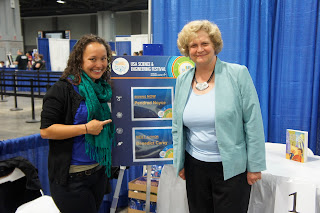
The 2nd USA Science and Engineering Festival enchanted and inspired visitors in Washington, DC last weekend, and I was there, representing both the Lexicon series and Tumblehome Learning.
Six members of my family attended, along with 150,000 other visitors over the course of three days. Seven Tumblehome staff and all four of our authors also attended for at least part of the weekend.
In our two combined booths, we set up posters, signs, and activities for Tumblehome Learning, the Land of Lexicon, and Morris Future Comics, the franchise that created our new graphic novel Venus: Daedalus One. We gave away tattoo stickers and trilobite keychains. At our main acitivity table, Peter Wong and Kristine ran a cycle of activities including making and painting plaster trilobites, experimenting with static electricity, and completing a flat circuit made of copper tape to make a buzzer sound.
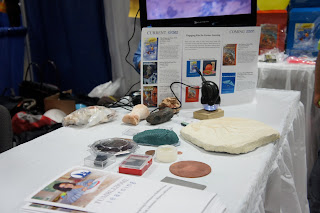
At another table, kids examined fossils, real or fake, with a microscope that projected images onto a screen. The kids could also examine tiny crystals of industrial diamonds and diamonds incorporated into the surface of silicon and other materials.
Finally, at the front, kids and parents did Tangram puzzles from the Lexicon Villages event and did a simple experiment about heat transfer and thermal paper.
Meanwhile, out the side of our booth we played a continuous loop of a slideshow and soundtrack for the first song of our upcoming Lexicon musical. The song in called "Because Girls Can't Do Math." Although the title is ironic, so many visitors got huffy at the very notion that we changed the title on the spot to "Because Girls Can('t?) Do Math."
A steady stream of visitors flowed through our booth all weekend, looking, playing, listening, signing up for more information, and buying. While kids did the activities, parents talked with our authors, Jeffrey Morris (author of Venus) and Michael Erb (author of Kelvin McCloud and the Seaside Storm).
The two activity kits and all four books available sold well, and visitors clamored for the two--Tumblehome Learning's The Furious Case of the Fraudulent Fossil and Scarletta's Ice Castle-- that are coming soon.
The festival itself was magnificent. Where else can kids see a space capsule, climb into an F-16 jet,
take apart an iPad, learn physics and circus tricks together, extract DNA, walk through the Magic Schoolbus,
enter a Rubik's cube contest,
Besides and see the Mythbusters all in one day? I had very little time to wander, but a did visit a few friends from the informal science world to see volunteers from 4H and the National Girls Collaborative Project running activities for younger kids.
Between manning the booth and visiting friends, I had a couple of author events to attend. One highlight was participating on an evening author panel about communicating science through books. Robin Cook of Coma and Outbreak fame, the creator of the medical thriller genre, delivered the keynote. Other writers included the great kids' nonfiction writer Joy Hakim and rocket boy turned multi-genre author Homer Hickam.
After Robin's talk, the six of us then sat on stage answering questions about how we came to write about science and our writing process.
I also gave a Featured Author talk Sunday morning. Unfortunately, it was first thing Sunday morning, in a rather hard-to-find but huge room two floors away from the festival main action, so if my family hadn't been ranged in the front when I started, I would have felt pretty lonely. Luckily, people trickled in as I spoke, and a decent audience gathered in time to see me use my Personal Assistant time machine to summon Roy Chapman Andrews, the paleontologist who served as the model for Indiana Jones.
I also gave a Featured Author talk Sunday morning. Unfortunately, it was first thing Sunday morning, in a rather hard-to-find but huge room two floors away from the festival main action, so if my family hadn't been ranged in the front when I started, I would have felt pretty lonely. Luckily, people trickled in as I spoke, and a decent audience gathered in time to see me use my Personal Assistant time machine to summon Roy Chapman Andrews, the paleontologist who served as the model for Indiana Jones. Roy stormed onto the stage in a panic about the Mongolian raiders chasing him in a scene taken more or less straight from Barnas Monteith's Fraudulent Fossil.
All this week the Tumblehome team has been recovering and following up from the fair. We sent copies of the song and coupons for THL products to all who signed up for them. We've begun entering our books on Amazon. We've established our warehousing and fulfilled new orders, updated our brochure and put the finishing touches on Fraudulent Fossil so it's ready for printing. We're already planning for a second run of Venus.
All in all, the festival was a wonderful place for the launch of a new science book and activity company. It was also a joyful event, and when (if) it happens again, all of you should bring your favorite children and attend!
| A corner of the festival during setup, before the crowds |
| Kids try out some activities |
At another table, kids examined fossils, real or fake, with a microscope that projected images onto a screen. The kids could also examine tiny crystals of industrial diamonds and diamonds incorporated into the surface of silicon and other materials.
| Fossils and diamond coatings. |
Finally, at the front, kids and parents did Tangram puzzles from the Lexicon Villages event and did a simple experiment about heat transfer and thermal paper.
| Rebecca helps a visitor with a heat transfer experiment |
A steady stream of visitors flowed through our booth all weekend, looking, playing, listening, signing up for more information, and buying. While kids did the activities, parents talked with our authors, Jeffrey Morris (author of Venus) and Michael Erb (author of Kelvin McCloud and the Seaside Storm).
| Michael Erb (left) and Jeffrey Morris sign their books. |
| Owen checks out Ice Castle |
The festival itself was magnificent. Where else can kids see a space capsule, climb into an F-16 jet,
take apart an iPad, learn physics and circus tricks together, extract DNA, walk through the Magic Schoolbus,
| Visitors line up to enter the Magic School Bus |
| Crowds watching the Rubik's cube challenge |
Besides and see the Mythbusters all in one day? I had very little time to wander, but a did visit a few friends from the informal science world to see volunteers from 4H and the National Girls Collaborative Project running activities for younger kids.
Between manning the booth and visiting friends, I had a couple of author events to attend. One highlight was participating on an evening author panel about communicating science through books. Robin Cook of Coma and Outbreak fame, the creator of the medical thriller genre, delivered the keynote. Other writers included the great kids' nonfiction writer Joy Hakim and rocket boy turned multi-genre author Homer Hickam.
![]() |
| Penny and Homer Hickam after the author panel |
| Book signing after the author panel |
| A visit from Roy Chapman Andrews, aka Barnas Monteith |
| Rhianon drops by her mother's book signing station |
All this week the Tumblehome team has been recovering and following up from the fair. We sent copies of the song and coupons for THL products to all who signed up for them. We've begun entering our books on Amazon. We've established our warehousing and fulfilled new orders, updated our brochure and put the finishing touches on Fraudulent Fossil so it's ready for printing. We're already planning for a second run of Venus.
All in all, the festival was a wonderful place for the launch of a new science book and activity company. It was also a joyful event, and when (if) it happens again, all of you should bring your favorite children and attend!
Friday, April 13, 2012
Because Girls Can't Do Math
Can girls do math as well as boys? Deep down inside, a lot of girls, parents, and teachers still don't think so. A recent study by Catherine Riegle-Crumb and Melissa Humphries at the University of Texas at Austin found that high school teachers rated the ability of white female math students as lower than that of white male students with comparable test scores and grades. In the study of 15,000 students, teachers were more likely to rate courses as being "too hard" for the girls enrolled in them.
Internalized gender stereotypes about who can and should do math develop early - as early as second grade, according to a study from the University of Washington. In the study, 247 children worked at a computer to sort boys' names, girls' names, and math or reading-associated words. They were quicker at their task when asked to associate boys' names with math words than when asked to associate those same math words with girls' names, indicating an implicit sense that girls and math just don't belong together.
Where do these stereotypes come from? It turns out that young girls are pretty good at picking up the beliefs around them. One study has shown that when female elementary teachers are anxious about math, their female students quickly internalize the belief that math is not for girls. As girls incorporate that belief, their achievement starts to lag.
But even when girls do well in elementary school math, it's true they have trouble keeping up in high school, isn't it?
Well, no, it's not. In 2008, Janet Hyde of the University of Wisconsin led a team studying the SAT and grade 4-10 math test results of 7 million US students. Whether they looked at average scores, scores of the most gifted students, or ability to solve complex problems, they found no significant differences between boys' and girls' achievement. The one place where boys outscore girls is on the math SAT, but this can be explained by sampling bias. Only kids who mean to go to college take the SAT, and these days that means more girls than boys take the test. The larger sample of girls dips more deeply into the achievement spectrum, bringing down average scores. At the same time, nearly half of all bachelor's degrees in mathematics go to women.
The persistent, often unconscious belief that girls just don't measure up in math inspired Todd Bearson, middle school math teacher and composer, to write a satirical song called "Because Girls Can't Do Math." It's the first song in the Lost in Lexicon musical now under construction. Here's a sampling of the lyrics:
But don't worry, it gets better when the girls strike back! If you'd like an mp3 of the song and a copy of the lyrics with brief notes about the women mathematicians mentioned, send a note to pnoyce@noycefdn.org with the title line, "Send Song." You'll enjoy it.
Internalized gender stereotypes about who can and should do math develop early - as early as second grade, according to a study from the University of Washington. In the study, 247 children worked at a computer to sort boys' names, girls' names, and math or reading-associated words. They were quicker at their task when asked to associate boys' names with math words than when asked to associate those same math words with girls' names, indicating an implicit sense that girls and math just don't belong together.
Where do these stereotypes come from? It turns out that young girls are pretty good at picking up the beliefs around them. One study has shown that when female elementary teachers are anxious about math, their female students quickly internalize the belief that math is not for girls. As girls incorporate that belief, their achievement starts to lag.
But even when girls do well in elementary school math, it's true they have trouble keeping up in high school, isn't it?
Well, no, it's not. In 2008, Janet Hyde of the University of Wisconsin led a team studying the SAT and grade 4-10 math test results of 7 million US students. Whether they looked at average scores, scores of the most gifted students, or ability to solve complex problems, they found no significant differences between boys' and girls' achievement. The one place where boys outscore girls is on the math SAT, but this can be explained by sampling bias. Only kids who mean to go to college take the SAT, and these days that means more girls than boys take the test. The larger sample of girls dips more deeply into the achievement spectrum, bringing down average scores. At the same time, nearly half of all bachelor's degrees in mathematics go to women.
The persistent, often unconscious belief that girls just don't measure up in math inspired Todd Bearson, middle school math teacher and composer, to write a satirical song called "Because Girls Can't Do Math." It's the first song in the Lost in Lexicon musical now under construction. Here's a sampling of the lyrics:
The female brain is a delicate flowerWhen exposed to math, it wilts and cowersThe way that they think means they don’t have the powerTo solve the kind of higher mindProblems we endure Because Girls…Can’t do math
Explaining numbers to girls is a waste like no otherWhy not teach a camel to sing?It can’t be done – why do such a thing? Women have a harder time with logicAll their emotions just get in their wayAnd they haven’t a shot at an abstract thoughtTo let them start would mock the artAnd lead us all astray.
But don't worry, it gets better when the girls strike back! If you'd like an mp3 of the song and a copy of the lyrics with brief notes about the women mathematicians mentioned, send a note to pnoyce@noycefdn.org with the title line, "Send Song." You'll enjoy it.
Thursday, April 5, 2012
Lucky Seven Meme and Previews
I just learned that a writer friend, Ardyth DeBruyn, mentioned me in a blog post called "Lucky Seven Meme." Ardyth writes adventure and fantasy with strong female characters and a wicked sense of humor.
The rules of Lucky Seven are this: I'm supposed to go to my current Work in Progress, find the
7th chapter,
7th page,
7th line,
and copy down the following seven lines or sentences.
Now, this might work for Ardyth, a prolific writer who likes to work on several books at once. For all I know, she could go to her seventh work in progress to start this off. Alas, I have only one Work in Progress at the moment, and I'm only on chapter 4. However, I have two books currently in press.
I turned to The Ice Castle, due out in August from Scarletta Press, only to find that the seventh chapter is the shortest chapter in the book. It has only eight lines (four sentences) on the last page. Still, I guess I'll give you the four sentences.
Varoq's huge feet raised clouds of snow that billowed around them as they whooshed across the plain.
A long time later, Ezengi spoke, and the sled creaked to a halt at the edge of a snowy field bounded by a low stone wall. Just ahead, the roofs of a town rose through the mist. Stomping toward them through the snow came a husky young man with a scanty mustache and a dark green bandana looped around his throat.
Hmm. Does this give you a sense of the book? I don't know.
Let me try The Desperate Case of the Diamond Chip, which is coming out from Tumblehome Learning at the end of this month. Here goes.
"Do you know Fairchild now has more people than the town I grew up in? I'd love to start small and brand new again." He fell silent, staring out the windown down at the valley, which was dotted with orchards, fields, and clusters of building.
"Why can't we go in the fab?" asked Clinton.
"The fab has to stay unbelievably clean. Even a hair or a flake of skin falling in the wrong place can ruin a batch of chips." He turned to Selectra.
The "he" in this passage is my father, Robert Noyce. Two time-traveling kids from our current day are visiting him, trying to learn enough about integrated circuits to solve a mystery in their present about a missing diamond semiconductor. Yes, science, mystery, time travel, and history, all in one slim volume! My father is gazing out the window of his small plane (he liked to fly) and wondering whether he should leave Fairchild to start the new company that became Intel.
The last step in the Lucky Seven game is to tag seven other authors. Here they are:
Marva Dasef , whose third Witches of Galdorheim book comes out this month,
Anne Ipsen, who primarily writes historical fiction,
Ardyth DeBruyn (cheating, obviously, since she tagged me),
Randy Susan Meyers, author of a harrowing novel of sorrow and survival called The Murderer's Daughters,
Denise Jaden, a Canadian author of contemporary YA fiction,
Mark Peter Hughes, author of Lemonade Mouth and other contemporary middle grade and science fiction that appeals to boys, and
Elle Strauss, writing YA and middle grade fiction. Give them a look!
Saturday, January 28, 2012
Off to Taiwan for the TIBE
The Taiwan International Book Exhibition is the largest book fair in Asia, with 500,000 visitors over the course of five days. Visitors include not just publishers, agents, and booksellers, but also teachers, parents, and kids who wander through the exhibition halls looking for fun and educational products.
Tumblehome Learning plans to operate on two continents from the start, with offices in Taiwan and the US. We're hoping to get a lot of cross-cultural enrichment, learning and sharing practices across both countries. Introducing ourselves at the TIBE is our way of starting that process.
I'll be leaving in the early hours of tomorrow morning for the 29-hour journey to Taipei, for a late Monday night arrival. (Taipei is thirteen hours ahead of Boston.) There I'll meet up with Tumblehome Learning's Taiwan staff, which currently includes our president, Barnas Monteith, and Yu-yi Ling, our Asian business manager.
We'll be there in Booth A907 in Hall 1, showing off the ARCs, Chinese and English, of our first books. We'll also display some engineering books from the Boston Museum of Science along with Lost in Lexicon and a teaser for The Ice Castle, which will be coming out in August.
We'll attend tea parties hosted by countries and publishers, and we'll meet with agents and publishing companies from other Asian countries to see if they have any interest in acquiring our products. We'll also talk to teachers and parents to get feedback on the idea of paired books and science activity kits as well as how the covers look, what font size to use in the final books, and other details.
In the second week I'll give a talk about a child's memories of the early days of Intel to Intel Taiwan employees, and Barnas and I will meet with education officials, science museum officials, printers, and leaders of technology. I'm really hoping to begin to understand the drive for excellence in science and technology that is so important in Taiwan. Maybe there are some things our own country can learn.
I'll post pictures and let you know how it goes!
Saturday, December 3, 2011
Is this a thesaurus?
This animal is only a little larger than William in Lost in Lexicon. Although you can't see his lips move, he is whispering helpful word choices in my ear.
The observers are the 4th and 5th grade Cool Girls club of Boulder, CO, and Mary Golden took the photo.
Thursday, October 13, 2011
A Visit to the College of St. Catherine
This morning I had a chance to talk to Kate Kelly's children's literature class for prospective teachers at the College of St. Catherine in St. Paul, MN. We spent some time discussing the media-saturated world our kids live in and what books still have to offer in building the vocabulary, knowledge base, and imagination of children. Then I talked about how I came to write Lost in Lexicon and what I was trying to accomplish in doing so.
Interspersed throughout, we played games. Here are some of the anagrams the students solved:
MARANGA
OIVDE
YEOHN
ILDRENCH
BRIANLIAR
SPOOTERHAP
We had to leave that word up a while, because even I had forgotten what it was. A student, though, figured it out. (Hint: it appears on pages 36 and 42 of the book.)
We also did activities and games with word roos, Tangrams, and the Flora activity from the Lexicon Villages event, which consists of building sentences (flowers) from words with different parts of speech printed on different colored petals.
We didn't have time for an activity involving the square root of two I wanted to try. Maybe next time.
I really like talking to teachers and student teachers, so if anyone has a group they'd like to visit, drop me a line. And here's a special cheer for BreeAnn, anagram champ, and Glamorous Amaris, who won a copy of Lost in Lexicon...plus all their classmates.
Interspersed throughout, we played games. Here are some of the anagrams the students solved:
MARANGA
OIVDE
YEOHN
ILDRENCH
BRIANLIAR
SPOOTERHAP
We had to leave that word up a while, because even I had forgotten what it was. A student, though, figured it out. (Hint: it appears on pages 36 and 42 of the book.)
We also did activities and games with word roos, Tangrams, and the Flora activity from the Lexicon Villages event, which consists of building sentences (flowers) from words with different parts of speech printed on different colored petals.
We didn't have time for an activity involving the square root of two I wanted to try. Maybe next time.
I really like talking to teachers and student teachers, so if anyone has a group they'd like to visit, drop me a line. And here's a special cheer for BreeAnn, anagram champ, and Glamorous Amaris, who won a copy of Lost in Lexicon...plus all their classmates.
Sunday, August 7, 2011
Illustrating Lexicon: Joan Charles and The Ice Castle
Last night I met Joan Charles, the wonderful illustrator of my Lexicon books, for the second time. Meeting with her is one of the main delights of coming to the annual Society for Children's Book Writers and Illustrators in Los Angeles, because Joan lives nearby. Last year we met for a brief drink. Joan was in the throes of finishing the artwork for Lost in Lexicon, and she confessed she had hardly poked her nose outside in weeks. She was pale.
This year, we're ahead of schedule. The Ice Castle will come out about a year from now, and Joan negotiated for a much more reasonable number of illustrations this time. She has completed sketches based on the book's second draft, and I've just sent both her and my Scarletta editor, Ian, the third draft, which has no plot changes substantial enough to require changing the artwork. That left us free to bond and converse.
We talked about the book, what happens emotionally with each of the kids, and what their individual growth arcs are. We discussed atmosphere (menacing? magical?)and clothing. Often I defer to Joan's visual sense. If she thinks a uniform would bring out the character more, we add a uniform. If she thinks a certain seating arrangement of characters around the dinner table would create more tension, I make sure not to contradict that in the text. On the other hand, I will sometimes tell her that I see a certain character as more imposing, funny-looking, or noble.
What made me really happy is that Joan feels this new draft is deeper and sharper than the first one, which she already loved. She sees the characters growing, and she's truly excited about creating their world. She confessed to me that she was doodling at a conference when she suddenly realized she had created one of the characters, Fort. The world of the book has invaded her subconscious, so she's in that wonderful creative state where she's working on it even when she doesn't mean to.
This year, we're ahead of schedule. The Ice Castle will come out about a year from now, and Joan negotiated for a much more reasonable number of illustrations this time. She has completed sketches based on the book's second draft, and I've just sent both her and my Scarletta editor, Ian, the third draft, which has no plot changes substantial enough to require changing the artwork. That left us free to bond and converse.
We talked about the book, what happens emotionally with each of the kids, and what their individual growth arcs are. We discussed atmosphere (menacing? magical?)and clothing. Often I defer to Joan's visual sense. If she thinks a uniform would bring out the character more, we add a uniform. If she thinks a certain seating arrangement of characters around the dinner table would create more tension, I make sure not to contradict that in the text. On the other hand, I will sometimes tell her that I see a certain character as more imposing, funny-looking, or noble.
What made me really happy is that Joan feels this new draft is deeper and sharper than the first one, which she already loved. She sees the characters growing, and she's truly excited about creating their world. She confessed to me that she was doodling at a conference when she suddenly realized she had created one of the characters, Fort. The world of the book has invaded her subconscious, so she's in that wonderful creative state where she's working on it even when she doesn't mean to.
Wednesday, July 13, 2011
The joys of revision
I am spending this week alone in Maine for two reasons: because I have a number of events and meetings here, and because I want to take advantage of the solitude to concentrate on revising the second Lexicon book, The Ice Castle. I'm making my way through about three chapters a day.
The story itself is in good shape. I'm not looking at major plot changes; I moved action around and eliminated a chapter last time through. What I'm doing this time is tightening and brightening.
For example, I'm making sure there are no dropped details. If Ivan puts leaves in his pocket in one chapter, he needs to use them in some later chapter. If he leans snowshoes against a wall, that better be where someone finds them later.
I'm tightening dialogue, checking to make sure that my kids sound like kids and the minor characters have distinct and consistent voices. In a similar way, I'm trying to give the minor characters names and brief descriptions that will make them stand out and stick in memory.
Point of view presents challenges of its own. Lost in Lexicon is told in two points of view, Ivan's and Daphne's. Ice Castle adds the point of view of their young cousin Lila. Juggling three points of view is more complex for both reader and writer. I need to make sure that every chapter starts with a strong indication of which character's eyes we're currently looking through. When I change POV mid-chapter, I have to do so for good reason, mark off the change with dingbats, plunge directly into the new viewpoint, and maintain it for at least a scene.
Next are the descriptions of place. What are the details that will make a reader feel s/he is actually within the scene? These details have to be strong but few. Kids have no love for long descriptions. Finding the right sensory details, details that are unique but convincing, is a challenge.
I'm also on the lookout for cliches either of language or of situation. Luckily, my editor is ruthless on this score. He won't let anything get by him that smacks of authorial laziness. He demands that I "unpack" each cliche: figure out what I really mean to say, figure out if it's genuine, and then find a better, more precise way to say it. It drives me crazy, but I think it makes the text stronger.
Closely related to cliches are gestures. I have to make sure I don't use the same ones over and over again. If Daphne bites her lip when she's thinking, I can't have Ivan and Lila doing the same. I need to make sure gestures are characteristic and genuine, not just padding to help me through a passage.
Finally, I look at words and sentences. Words can't repeat too often in close proximity. Unintentional rhymes and excessive alliteration have to be eliminated. Sentences need to flow. When this revision is done I'll read it aloud to one or more family members, making sure the words run smoothly and don't get caught on too many hidden snags.
Some authors hate revising. I like it. Sure, there are times when I get frustrated and take a break to go down to the dock and watch the cormorants swimming so low in the water they look about to sink. But then I go back. I have a story, I care about my characters, and I want to touch up, highlight, and polish until readers can experience the story I see in my mind.
The story itself is in good shape. I'm not looking at major plot changes; I moved action around and eliminated a chapter last time through. What I'm doing this time is tightening and brightening.
For example, I'm making sure there are no dropped details. If Ivan puts leaves in his pocket in one chapter, he needs to use them in some later chapter. If he leans snowshoes against a wall, that better be where someone finds them later.
I'm tightening dialogue, checking to make sure that my kids sound like kids and the minor characters have distinct and consistent voices. In a similar way, I'm trying to give the minor characters names and brief descriptions that will make them stand out and stick in memory.
Point of view presents challenges of its own. Lost in Lexicon is told in two points of view, Ivan's and Daphne's. Ice Castle adds the point of view of their young cousin Lila. Juggling three points of view is more complex for both reader and writer. I need to make sure that every chapter starts with a strong indication of which character's eyes we're currently looking through. When I change POV mid-chapter, I have to do so for good reason, mark off the change with dingbats, plunge directly into the new viewpoint, and maintain it for at least a scene.
Next are the descriptions of place. What are the details that will make a reader feel s/he is actually within the scene? These details have to be strong but few. Kids have no love for long descriptions. Finding the right sensory details, details that are unique but convincing, is a challenge.
I'm also on the lookout for cliches either of language or of situation. Luckily, my editor is ruthless on this score. He won't let anything get by him that smacks of authorial laziness. He demands that I "unpack" each cliche: figure out what I really mean to say, figure out if it's genuine, and then find a better, more precise way to say it. It drives me crazy, but I think it makes the text stronger.
Closely related to cliches are gestures. I have to make sure I don't use the same ones over and over again. If Daphne bites her lip when she's thinking, I can't have Ivan and Lila doing the same. I need to make sure gestures are characteristic and genuine, not just padding to help me through a passage.
Finally, I look at words and sentences. Words can't repeat too often in close proximity. Unintentional rhymes and excessive alliteration have to be eliminated. Sentences need to flow. When this revision is done I'll read it aloud to one or more family members, making sure the words run smoothly and don't get caught on too many hidden snags.
Some authors hate revising. I like it. Sure, there are times when I get frustrated and take a break to go down to the dock and watch the cormorants swimming so low in the water they look about to sink. But then I go back. I have a story, I care about my characters, and I want to touch up, highlight, and polish until readers can experience the story I see in my mind.
Monday, June 6, 2011
A great surprise review
Today I received unexpected notice of this great, sarcastic review of Lost in Lexicon in Open Letters Monthly Review.
I didn't know about this online review of arts and literature, but I like their mission statement:
I think this review sparkled. And I wonder if Steve Donoghue always reads with a basset hound on his lap.
I didn't know about this online review of arts and literature, but I like their mission statement:
Open Letters is dedicated to the proposition that no writing which reviews the arts should be boring, back-patting, soft-pedaling, or personally compromised. We’ve all had the experience of reading a review that sparkled—one that combined an informed, accessible examination of its quarry with gamesome, intelligent, and even funny commentary.
I think this review sparkled. And I wonder if Steve Donoghue always reads with a basset hound on his lap.
Saturday, June 4, 2011
Metaphors at the State Science Fair
Here is a selection of the tasty similes and metaphors middle school students from the Massachusetts State Science and Engineering Fair contributed today to the Mistress of Metaphor's pot (Students pick up a prompt and complete it in this activity related to my book Lost in Lexicon):
I sat down and cried like... a river flowing down after a big melt.
Annoying as... a dog barking in the middle of the night.
Tall as... a skyscraper looming over a city.
The setting sun was... like an orange Jello over the horizon.
My bed at the end of the day was... messy and unclean like after a tornado. [We did have tornadoes in Massachusetts this week.]
My old dog panted like... an old train exhausted from travel.
Cold as... winter's frost infested breath.
The setting sun was... a falling fiery red cannon ball the size of the moon.
Dark as... a night alley.
We ran out of there like... a herd of wild buffalo being chased by Indians.
I sat down and cried like... a baby that just had a shot.
The night sky was... ominous as a wizard lifting his cape.
Three hundred middle school kids, selected from their school science fairs all across the state, attended the state science fair today. They were a very diverse group, about equally divided between boys and girls, with a good representation of black, white, Hispanic, East Asian, South Asian, and Middle Eastern students. I saw projects on using pheromones to trap males of invasive crab species; testing how far a soccer ball flies when it's inflated to different pressures (and struck by a mechanical foot); testing what characteristic of a glass determines its resonant frequency, and many more. There were bubbles, sugary drinks, music played to growing plants, solar-powered hydrolysis, and a model of tide power.
All of this, and they were also good with words. I left feeling proud of Massachusetts students and optimistic about the prospects for innovation and discovery among the rising generation.
I sat down and cried like... a river flowing down after a big melt.
Annoying as... a dog barking in the middle of the night.
Tall as... a skyscraper looming over a city.
The setting sun was... like an orange Jello over the horizon.
My bed at the end of the day was... messy and unclean like after a tornado. [We did have tornadoes in Massachusetts this week.]
My old dog panted like... an old train exhausted from travel.
Cold as... winter's frost infested breath.
The setting sun was... a falling fiery red cannon ball the size of the moon.
Dark as... a night alley.
We ran out of there like... a herd of wild buffalo being chased by Indians.
I sat down and cried like... a baby that just had a shot.
The night sky was... ominous as a wizard lifting his cape.
Three hundred middle school kids, selected from their school science fairs all across the state, attended the state science fair today. They were a very diverse group, about equally divided between boys and girls, with a good representation of black, white, Hispanic, East Asian, South Asian, and Middle Eastern students. I saw projects on using pheromones to trap males of invasive crab species; testing how far a soccer ball flies when it's inflated to different pressures (and struck by a mechanical foot); testing what characteristic of a glass determines its resonant frequency, and many more. There were bubbles, sugary drinks, music played to growing plants, solar-powered hydrolysis, and a model of tide power.
All of this, and they were also good with words. I left feeling proud of Massachusetts students and optimistic about the prospects for innovation and discovery among the rising generation.
Thursday, May 5, 2011
Larry Davidson, Brookline's Pi Man
I just stumbled across this lovely blog post about last month's Lexicon evening in Brookline. Larry Davidson teaches math at Weston High School, where he taught two of my kids. He's an enthusiast of linguistics, and he also has a sister who teaches at both the college and elementary school level. It was Ellen Davidson who introduced a club of fourth grade readers to Lost in Lexicon, and it was the boys, now my favorite fourth graders, who invited me to bring Lexicon to their school.
Larry, as he explains in his post, staffed the village of Irrationality, helping kids use measurement to approximate pi.
Because of a promise made by the Mistress of Metaphor, I owe each of those boys a manuscript copy of The Ice Castle, which is still in draft form. I'll send the copies out tomorrow, I promise!
Larry, as he explains in his post, staffed the village of Irrationality, helping kids use measurement to approximate pi.
Because of a promise made by the Mistress of Metaphor, I owe each of those boys a manuscript copy of The Ice Castle, which is still in draft form. I'll send the copies out tomorrow, I promise!
Sunday, April 3, 2011
Lexicon in Brookline
On a sleety Thursday night at the Driscoll School in Brookline, Massachusetts, over a hundred parents and students turned out for an evening in Lexicon. Maybe it was the offer of pizza that brought them, but the pizza ran out early, and they were cheerful anyway. We let the still-hungry hordes in to the ten stations staffed by parent and teacher volunteers, some of them in costume and in character. Miss Needle was wrapped in ribbons marked with numbers at irregular intervals, Lily of Flora was wreathed in flowers, and Zeta of Irrationality was dramatic, beautiful, and a little scary in her dress and long dark hair.
The kids, from grades 4 to 6, picked up their Lexicon Travel Guides and crowded around the tables. They fed synonyms to Emily and found metaphors for the Mistress of Metaphor. They measured with erasers and paperclips instead of rulers, and they relied on measurement to calculate the approximate value of pi. (They worried when their calculations didn't come out close "enough.") They coaxed the feuding parts of speech of Flora together by arranging colored petals marked with words into full, multicolored sentences. Tangram puzzles and the mirror maze were favorites, as usual. Kids and parents used word roots to make up words of their own, and they rescued and decorated words from the trashcans of Brevity.
What was so impressive was not just the turnout but the way parent involvement translated into kid enthusiasm and persistence. The kids wanted to complete each task and do it well. Parents came up to me to thank me for coming; all I wanted to do was tell them what great parents they are. I signed books so fast my signature got messier and messier.
To give some kids a break from the noise and activity, we reconvened in the computer room, where I talked to them about writing a book and where ideas come from. Then it was time to clear up and head back out into the sleet. But all of us involved with Lexicon came away elated at how a school community of dedicated staff and attentive parents can make learning such a celebration. Here's to the people of the Driscoll School, to Ellen Davidson and her math group, and especially to Izzy, the fourth grader who first invited me.
The kids, from grades 4 to 6, picked up their Lexicon Travel Guides and crowded around the tables. They fed synonyms to Emily and found metaphors for the Mistress of Metaphor. They measured with erasers and paperclips instead of rulers, and they relied on measurement to calculate the approximate value of pi. (They worried when their calculations didn't come out close "enough.") They coaxed the feuding parts of speech of Flora together by arranging colored petals marked with words into full, multicolored sentences. Tangram puzzles and the mirror maze were favorites, as usual. Kids and parents used word roots to make up words of their own, and they rescued and decorated words from the trashcans of Brevity.
What was so impressive was not just the turnout but the way parent involvement translated into kid enthusiasm and persistence. The kids wanted to complete each task and do it well. Parents came up to me to thank me for coming; all I wanted to do was tell them what great parents they are. I signed books so fast my signature got messier and messier.
To give some kids a break from the noise and activity, we reconvened in the computer room, where I talked to them about writing a book and where ideas come from. Then it was time to clear up and head back out into the sleet. But all of us involved with Lexicon came away elated at how a school community of dedicated staff and attentive parents can make learning such a celebration. Here's to the people of the Driscoll School, to Ellen Davidson and her math group, and especially to Izzy, the fourth grader who first invited me.
Tuesday, March 8, 2011
Lexicon at the Discovery Museums, Acton
The Acton Discovery Museums consist of a children's museum and a science museum tucked away off the main street of one of Boston's western suburbs. Sunday my team and the wonderful museum staff held a Lexicon Villages event there, with village stations scattered throughout the museum. At the door, Mr. Frank Lee Officious greeted visitors and gave them travel guides and pencils. Then he encouraged them to think of synonyms for Emily the Thesaurus. When they fed her he gave them Emily wristbands. Next the Mistress of Metaphor asked them to come up with metaphors to stir into her pot.
Upstairs, visitors found some math stations. In one they could measure and calculate pi; in another they used non-standard measures like paper clips to measure a book. They also had the chance to compare their stride lengths as they strode from one wall of the museum to another. Integrated into museum displays were two more stations where they could work on Tangram challenges or practice completing a maze while looking at it only in a mirror.
In a side room, my nephew Mat, a museum employee, and I staffed three word stations. In one, visitors constructed new words from Greek and Latin roots. In another, they formed flowers (sentences) from different colored petals (parts of speech). In the final station, they rescued words that had been discarded in Lexicon's village of Brevity. Visitors decorated the words - words like conflagration, iridescent, and rebellion - and carried them off to safety.
Two things were really fun about this event. First, the setting was great. The Science Discovery Museum isn't large, but every wall, corner, and staircase is crammed with objects for kids to explore, from the plumbing wall where you can direct water flow to the mist tornado to every kind of noise-making (musical?) instrument to hanging spheres that smash together to demonstrate conservation of momentum. Second, it's fun to see kids and parents interact over the Lexicon activities, which we can adapt on the spot to different ages.
Each time I hold one of these events, the volunteers come up with new twists and improvements, such as little signs describing the parts of speech or a chart made up of ribbon lengths visitors had cut for the diameters and circumferences of round objects they had measured. Eventually (soon) I'm going to be able to put the entire event guide up on the Lexicon website for anyone to see. That way schools or book clubs could either run their own event or know what they're getting into if they ask me to do so, and I'll know more kids and parents are playing together with words and numbers.
Wednesday, October 6, 2010
Albuquerque and the Balloon Festival

I've come to Albuquerque during the Balloon Fiesta for a Lexicon event at Alamosa Books, a wonderful new children's bookstore in the northeast of the city. Yesterday I drove my rental car to the store, where I unloaded and sorted all the needed supplies. Happy with the site and the preparations, I slung the heavy suitcase into the trunk, slammed it shut -- and experienced a foreboding sinking feeling.
Sure enough, the car keys were nowhere to be found, and the car was locked with my purse inside. So I spent an our reading large print children's books while waiting for the Hertz-designated locksmith to come let me in.
Today started much better. I drove down to the Balloon Fiesta Park in time to see most of the 7:30 am mass launch. In quick succession and sometimes three or four at a time, the air in the balloons is expanded with a whoosh of flames. The envelope fills, rounding out, and the balloon rises and immediately starts drifting east toward the mountains. There are colorful balloons, balloons advertising some hotel or country or business, and shaped balloons --Darth Vader's head, a Coke can, Smokey the Bear ("Who's Smokey the Bear?" I heard a ten-year-old asking his father), a huge pig, a ladybug, and even a pair of kangaroos, each with two baby kangaroos packed in her pouch.
All around me, people were taking photos with nice cameras and telephoto lenses. I had my i-phone, and when I figure out how, I'll upload a picture or two so you can see distant, dark, unimpressive balloons that don't convey the sense of things at all. Sigh.
Friday, September 24, 2010
Radio KLVI
Last night I had my first ever radio interview, on KLVI Radio 560 in Beaumont, Texas. The topic was the dual languages of math and literature, and the interview was fast-paced, interactive, and I think very good.
The other big piece of news today is that Lost in Lexicon in in stock at Amazon. My ranking at Amazon is over 1 million. I'm really curious to see what happens to that ranking as people start buying!
Subscribe to:
Posts (Atom)