Showing posts with label The Ice Castle. Show all posts

Friday, December 7, 2012

Remembering Kit Ward


I met Kit Ward when she was an acquiring editor at Little, Brown.  She had just read the manuscript of my novel Tulku, and through my agent she asked me to come in and talk about it.  Needless to say, I jumped at the chance.

I arrived in Kit's cozy Boston office to find a kind, soft-spoken woman only a couple of years older than I.  She liked the novel, she said, and she thought it had promise, but it needed more work.  She spent an hour going through the manuscript with me, showing where she needed more character development, sharper description, braver confrontation of the book's themes.  She spoke in a lovely, soothing voice.  I agreed with her suggestions and promised to work on them.  On my way out, Kit gave me a book.

Three months later, I sent her the revised manuscript.  She liked it and took it to the Acquisitions Committee.  On the day of their meeting, I sat anxiously by the phone, waiting for my agent to call.  I already felt bruised and raw.  Two days before, my father had died suddenly at the age of 62, and my husband and I were about to fly to Texas for his memorial service.

My agent called. "I'm sorry. They said no." He told me he had nowhere else to send my novel. It was over.

The next week, after I was home from Texas, Kit called me.  She had fought for the book, she said.  The sales team had turned it down because they didn't know how to describe it in a single phrase.  It used to be, she told me, that a publishing house like Little, Brown would take on a young author who seemed promising but not a sure bet.  An editor would work with that author over time, helping to grow her talent.  Now those days were gone.  But, Kit said, she still believed in my novel.  Soon she would be leaving Little, Brown to start her own literary agency.  She'd love to represent me. But that would take a few months, and in the meantime, she'd refer me to her friend Millie Marmur.

Millie tried to sell the book, but without success. By the time Kit became my agent, there was really no place else to send it. Kit tried to be encouraging. She suggested I write a memoir about growing up in Silicon Valley as my father started Intel. I wasn't ready for that. I tried to write a few stories, but my heart wasn't in it.  I took the creativity I had poured into my writing and applied it to helping establish the Noyce Foundation instead. I threw myself into math and science education. Kit and I lost touch.

Years later, when I had written Lost in Lexicon and couldn't find an agent for it, I stumbled across Kit's phone number.  Holding my breath, I dialed the number from fifteen years earlier. "Hello, this is Penny Noyce," I said, hoping she would remember me.

"Penny, I was just thinking about you!" Kit exclaimed.

I sent her Lost in Lexicon, a brainy fantasy adventure in a world of words and numbers.  Kit loved it, and though it had been years since she'd last represented a children's book, she took it on.

The year dragged on.  Kit forwarded rejection notices. She told me the editors she had carefully selected, thinking they would love the book as she did, found it too old-fashioned and didactic.  Finally, after a year, her voice full of regret, she told me she couldn't sell the book.  "I think it's a wonderful book," she said. "But I've decided not to take on any more children's books. I don't understand the children's market anymore." And then she asked, "What are you going to do?"

I was going to publish the book myself, I said. And I was going to do it right, with proper editing, design, and art. Kit offered to help me navigate the process.  She introduced me to a friend, Karen Klockner, who served as art director and guided me through the publishing process.

Lost in Lexicon won awards and succeeded in the marketplace so well that Scarletta Press decided to publish a second edition to make it the cornerstone of their new children's line.  George Ward, Kit's husband, supplied the mathematical drawings for both Lost in Lexicon and its sequel, The Ice Castle.

As one small way of thanking Kit for her faith in me during the stuttering years of my writing career, I named a character in The Ice Castle after her. The Kit of the book is a kitchen servant, loyal and industrious and brave. She has a beautiful speaking voice.

Just after Thanksgiving, Kit Ward died suddenly after a brief and catastrophic illness. I'll miss her.  Her voice at the other end of the phone line always left me feeling comforted, encouraged, and uplifted.  I felt a strange guilt when I learned Kit had died of pancreatic cancer, the same disease I gave Great Aunt adelaide at the start of The Ice Castle.

Remembering Kit, I still seek good solid editing for my own writing. At the same time, I've become an editor myself, working with authors over time to polish their work and hone their skills as they write for Tumblehome Learning.  And oddly, after all this time, as I work on adapting for children a biography about my father, I find myself making the book half biography, half memoir. The book is going to be called Do Something Wonderful.  I wish I could show it to Kit.

Sunday, November 11, 2012

Fun with Malapropisms

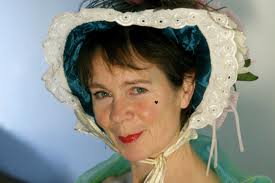
What is a malapropism?  It's a form of speech error named after the comic character Mrs. Malaprop in Richard Sheridan's 18th century play The Rivals.  Here she is:  a talkative woman with intellectual pretensions, using words whose meanings she doesn't really know.

Celia Imrie as Mrs. Malaprop

For example, Mrs. Malaprop says of an acquaintance that "she's as headstrong as an allegory on the banks of the Nile."  She advises another character, "Illiterate him from your memory." She replaces "alligator" and "obliterate" with other, similar-sounding words.

These examples illustrate several important points about malapropisms.

1) A proper malapropism is always a real word.

2) The mistaken word is almost always the same part of speech as the word meant.

3) The mistaken word is usually the same number of syllables as the word meant.

4) The pattern of stresses laid on the syllables is usually the same, as in "alligator" and "allegory" or "obliterate" and "illiterate."

For comic effect, it's good if both the words replaced and the words used to replace them are rather uppity words.

In my novel The Ice Castle, the nomad chief Kanzat fancies himself master of a large vocabulary. He uses big words whenever he can, and often as not he misuses them.  Some of his mistakes are malapropisms; others are neologisms, where he makes up a word that sounds right.

When Kanzat first meets Ivan and Daphne, he uses a number of made-up words:
And envoyed from which commune, shall I ask?
You haven't journaled far, not without tents nor furs nor weapons.
Mute, eh? Speakless but spoke for, I take it?

At other times, he uses real words incorrectly.  These are the true malapropisms. In the middle of the story, Kanzat says of a message he is delivering:
It discerns the little singer.
One of [the Diva's] courtiers, the Lord High Chamberpot or whoever, gave me this and disclaimed it most urchin to deliver. 
Tell me what the missile says. 
In literature, malapropisms are used for comic effect, usually to poke fun at a pretentious person posing as more educated than he is. That's a good description of Kanzat. For me, including him in the second Lexicon book (whose subtitle is An Adventure in Music) provides a way of returning briefly to the kind of wordplay that make the first Lexicon adventure, Lost in Lexicon, such fun to write.

Part of the fun of malapropisms involves introducing ridiculous images in the reader's mind.  In writing these malapropisms, I couldn't help but picture a royal official squatting over his chamberpot and an unwashed, ragged child delivering a missive that shoots out of her hand.

Have you ever  uttered a malapropism?  Have you heard others use them?  Do you have a favorite you've read or heard?  Send them in!

Wednesday, October 17, 2012

Ten sharp facts about glass

obsidian

In my middle grade novel The Ice Castle, Daphne's friend Mr. Silica runs a glass factory that plays an important role in the story. As I poked around researching the book, I learned a lot of fascinating tidbits about glass.

1.   The definition of glass is "an amorphous solid," which means a solid with no crystal structure, where the atoms and molecules are arranged more or less at random.

2.  Volcanic glass is created when magma cools suddenly, not allowing crystals to form in the cooling rock.  One common form of volcanic glass is obsidian, black, smooth, and shiny.


3.  Another natural form of glass is found in fulgurites -- glass tunnels made when lightning strikes sand and heats it to its melting point. The Museum of Science in Boston has a fulgurite many feet long.

The sand cast of a fulgurite several inches long
Fulgurite - see the glassy inner surface
4.  The earliest glass was made in Mesopotamia and Egypt in 3500-2500 BCE.  Early glass beads may have been formed accidentally as sand melted in the slag heap of furnaces for purifying metal.

5.  The Romans were probably the first to use glass for windows, around 100 CE.  Glass windows did not become common in ordinary houses in England until about 1500 years later.  Other houses still used animal horn to keep the cold out while allowing entry of some light.

Tinted float glass
6.  The most common form of manufactured glass today, soda lime glass, is made up mostly of silcon oxide, or sand.

7.  To make large flat panes, molten glass used to be poured and allowed to spread on a flat surface, which led to the glass being thicker in the middle.  To address this, glassmakers spun the flat surface, leading to thicker glass around the edges.

8.  Today, flat panes of glass are often made by the "float glass" method, in which molten glass is floated on another liquid surface, such as molten tin.  Gravity smooths and flattens the glass.

9. Manufactured glass can be colored, but it is valued for its transparency.  About 92% of the light that falls on a pane of clear glass passes right through.

10.  "Gorilla Glass," first developed by Corning in the 1960's and perfected for Apple products, is a strong, hard, flexible glass that is difficult to scratch.  Gorilla glass is now used in hundreds of millions of mobile phones, computer displays, and other screens.


Gorilla Glass from Corning

Glass, from skyscraper windows to contact lenses, is an amazing bit of technology that has been part of our lives for millennia and yet continues to improve.  In The Ice Castle, ambitious Itzo Silica worries whether he can improve his technique enough to fill a mysterious order from the Palace of Music...but he won't reveal to anyone what the order is for.

Wednesday, September 5, 2012

Inventing a musical instrument

When I was a medical student, I had a neighbor named Danny who lived across the street.  He was young and brilliant with computers, and he played the violin.  But he had one ambition that puzzled me: he wanted to invent a musical instrument.

Glass harmonica
In my unmusical way, I tried to imagine what a new instrument might be.  What family would it be in, I asked Danny: wind? string? percussion?  He just shook his head.  I disappointed him by thinking within the grooves of old paradigms. But the only instrument I could think of that really broke out of these categories was the glass harmonica.

The truth is, I don't know if Danny ever invented his instrument, but this evening I heard a story on NPR about John Cage (1912-1992), who played an important role in avant-garde art and music.  His most famous musical piece, perhaps, is 4'33," a piece where the musician sits at the piano not playing for four minutes and thirty-three seconds while the (initially puzzled) audience hears ambient sound.

John Cage
Cage, whose hundredth birthday would have been today, also experimented with "new" instruments, which were essentially variations on old ones.  For example, he used the "prepared piano," which is a piano with various objects stuck between the strings.  This instrument combines piano notes with percussion. Presumably a musician could do the same thing with a guitar or even a harp. People can also strike their fist on the strings of the piano or click on the keys of a woodwind instrument without blowing into the mouthpiece.  According to Wikipedia, some even put a saxophone mouthpiece on a trombone.  But none of these would have satisfied Danny; they're all just variations.

A new way of producing electronic music might have satisfied him, but I think he was looking for something simpler and more concrete, a new way of creating vibrations. In place of a vibrating string, drumhead, or air within a column, why not ball bearings rolling in a pot or balloons of different size rubbing together... or... or... well, you think of something.

Morris dancers - an inspiration for the miners of Lexicon?
In THE ICE CASTLE, a half-crazed hermit sits deep in a cave trying to invent musical instruments.  In fact, he's trying to re-invent them in a society that has banned them.  He ropes Ivan, one of the novel's protagonists, in to help him.  Ivan is frustrated to realize that although he's familiar with lots of musical instruments at home, he hasn't examined any of them closely enough to draw one or fully explain how it works.  Now there's a thought experiment: if you were stranded in a completely alien culture, could you show them how to make the musical instruments that are so familiar to us?


In the end, with the help of an ancient manuscript, some mathematics and some experimentation, Ivan succeeds in helping the hermit.  He figures out the principle behind tuning stringed instrument. Ivan and his friend Fort also find a way to make an entire band of miners, dancing with bangles on their wrists and ankles, into a kind of group musical instrument.  I guess in the end Ivan did invent a new musical instrument--and so did I.  I just haven't tried to play it yet.


Monday, August 6, 2012

Boy singers and an earlier voice change

We all know that boys' voices change during adolescence. Now we're learning that the embarrassing tendency to squeak when speaking may be occurring ever earlier. Currently, a boy's voice starts to change around age thirteen, and a boy is likely to speak in his adult male voice by age fifteen.

Franz Hals - Two Boys Singing
But the voice change hasn't always come so early, as the Washington Post reports. Records from Liepzig's St. Thomas Boys Choir, which is 800 years old, suggest that in the first half of the 1700's, when J.S. Bach led the choir, most boys' voice change began at age 17 or 18.  Moreover, during wartime, when hunger was common in the city, the voice change began even later.  So maybe better nutrition accounts for today's falling age of male voice change.

On average, the pitch of a male's speaking voice falls by about one octave as he passes through adolescence. Singing teachers have assured me, however, that a boy's adult singing range cannot be predicted from his childhood range.  You can't assume that an alto will become a bass while a soprano will become a tenor.

Voice change can be a challenge for all chorus directors, not just those in an elite boys' choir like Liepzig's. As boys' voices become less predictable, they also lose some ability to sing on pitch and sing intervals correctly. Their vocal range may also simply contract for a while. Boys may become discouraged and drop out of a choir or school chorus. Directors of a middle school musical may find their male lead suddenly unable to sing the part. Girls may have to fill boys' roles because too few boys are willing to risk singing.

To me it's telling that we talk about boys' voices "breaking," not just changing.  Maybe the term reflects  our unconscious sense that our sons' adolescence is a loss -- loss of innocence, loss of closeness, loss of beauty and loveableness.

In the Land of Winter, the imaginary setting for my middle grade fantasy THE ICE CASTLE: AN ADVENTURE IN MUSIC, singing ability is each person's defining characteristic, determining social class and educational opportunity. Although I don't directly address how this society handles boys' voice change, I doubt that it does so with any great compassion. After all, there is no place in society for the visitor Ivan, who sings badly. And when Fort, a talented singer, finds his voice ruined by a botched throat surgery, his adoptive family throws him out of the house.

In some ways, THE ICE CASTLE is a parable of the passage through adolescence, where voice change is only one of many troublesome changes. Other signs of passage touched on in the book include increasing independence from parental control, learning to see beyond one's own excessive self-regard, and learning to delight in creativity and invention.

In reality, most chorus directors and singing teachers nowadays encourage boys to keep singing through the voice change. They allow boys to change parts or select music with a narrower range and less challenging intervals. Even if they decide to let the boys take a break, they assure them of their place in the chorus and welcome them when they return.

The choir directors of St. Thomas may rush to fill boys' heads and voices with as much musical knowledge as possible between ages 9 and 12, but that doesn't always work even with music.  Most parents and teachers know that adolescence comes upon our kids before we or even they are ready for it. All we can do is hold their place, keep teaching, and work to assure them that adolescence is a continuation of growth, not a sudden break from childhood.


Sunday, August 5, 2012

THE ICE CASTLE launches

THE ICE CASTLE: AN ADVENTURE IN MUSIC, second in the Lexicon Adventure series, officially launches this week, and I'm truly excited.  It's a beautifully printed book, and I'm attached to the story and the characters.

The book opens in December. Aunt Adelaide is ill, and the family gathers, including Daphne and Ivan's younger cousin Lila, a gifted singer. Lila stumbles into Ivan and Daphne's secret land of Lexicon, and in an attempt to rescue her, they follow her into the snowy Land of Winter. Kidnapped by nomads, they are delivered to the town of Capella, where they learn that all that matters for social status and opportunity is how well a person sings.

Lila is celebrated and elevated, while Daphne starts off a schoolgirl and becomes a servant, and Ivan, who is tone deaf, is relegated to life as a laborer, until his rebellious nature gets him sent off to work in the silver mines.

I had a lot of fun writing this book, not least in creating the supporting characters.  There's Fort, adopted child of a high-status family who is disinherited after a botched throat operation ruins his voice.  He becomes a charismatic Dissonant leader, a romantic figure who dazzles Daphne.  There's Kanzat, the nomad chief whose love of fancy words leads him into delicious malapropisms.  There's the grubby and irascible Hermit of the Mine, to whom Ivan apprentices himself to forge a path to freedom.  And there's the glorious and exacting Diva, ruler of the Land of Winter, who each year must summon the spring by singing her way free of a castle built of ice.

I tell the three cousins' stories in alternating chapters that weave apart and together as each follows his or her own story arc.  Lila finds independence and courage to escape from under the thumb of a domineering mother. Daphne moves beyond envy and resentment to embrace loyalty and humble open-mindedness while protecting Lila from a hidden enemy. Ivan embarks on a journey of creativity as he invents his way out of captivity. Each plays a role in bringing greater justice to the Land of Winter. Orchestrating their movements and roles was half the fun of writing THE ICE CASTLE.

Now comes the next step, presenting the book. As with Lost in Lexicon, I've developed an Ice Castle activity fair to use in schools or with groups of readers.  Scarletta Press has produced a short movie introducing some of these activities with ice, melting, and music.  I'll run two of these fairs soon at the Discovery Museum in Acton, MA, first for a group of kid readers and then again at the book's launch party September 23, 2012, to which you're all invited.

We've also updated the Lexicon website, adding new characters, new stops on the map, and two new, musical games.

I truly hope some of you will join the fun of THE ICE CASTLE launch by visiting the website and buying the book. Sometimes people ask whether it's better to buy from the website, their local bookstore, or from an online groups like Amazon or Barnes & Noble.  The truth is, any one is great.  When you request the book from your local independent bookseller, you support local business and diversity, and you encourage them to stock the book. If you buy from Amazon or B&N (and even if you don't), you can make a great contribution by writing a short review or even more easily by "tagging" the book with categories that will help other readers searching for good books that, say, combine fantasy with music. And of course if you order from the website, you can get your book autographed.  So please cool off in this hot month of August with a visit to the musical wonders and snowy landscapes of THE ICE CASTLE.  Let us know what you find!


Wednesday, February 22, 2012

What's new in Lexicon?

Lexicon is still my first love, even as I strike out on other writing and publishing adventures. And this week has been an exciting one. First, I learned from my publisher that The Ice Castle is now available for pre-order on Amazon and Barnes & Noble. The catch: actual publication date isn't until August 14. But the Barnes & Noble deal, at least, is really excellent: 43% off list price.

The Ice Castle brings Ivan and Daphne back to Lexicon - but this time accompanied by their musically talented younger cousin Lila. The three cousins are lost in the Land of Winter, where all that matters is how well you can sing (Ivan can't at all), and spring won't come until the Diva... but I don't want to ruin it for you. Let me just say that there are bears, musical leaves, prison, silver mines, a palace, a handsome rebel, an old enemy, and lots and lots of snow, not to mention lovely artwork by Joan Charles.

In a second exciting occurrence this week, I received my first royalty check from Scarletta Press. Although this is not the first time I've been paid for my writing, it's the first time I've been paid a royalty from an established publisher. Getting a royalty check is a bit like getting any other paycheck for the first time: you're stunned by how much they take out. Distribution fee, reserve against returns - but still, it's a recognition of your work in the marketplace.

Third, this morning I finished the first chapter of my first draft of the third book in the Lexicon series, which I expect to call The Harbor of Bezant. I've been mulling this book over for about a year, and now my schedule has cleared enough to let me start putting it on paper. Or rather, on a hard disk, which is what substitutes for paper now.

Tomorrow I take off on another grand adventure, this time a long-scheduled voyage to Argentina with select friends and family. My hope is that I'll be able to report from Bahia Bustamante on the Patagonia coast, from Buenos Aires, and from an estancia. And I mean to use some quiet mornings to write.

Thursday, December 8, 2011

Ice Castle copy editing is finished

Today I received a copy-edited draft of The Ice Castle, an Adventure in Music, which is the sequel to Lost in Lexicon. Here's the blurb:

Their return to Lexicon is not all that Ivan and Daphne imagined. For one thing, Aunt Adelaide is deathly ill. For another, their musical younger cousin, Lila, has stumbled into their secret land.
Instead of rejoining old friends in the Land of Morning, Ivan and Daphne find themselves tracing Lila through a wintery landscape where what matters most is how well a person sings.

Sorted by musical talent and consigned to different lives, the cousins face cold, illness, and attempted murder. Slave, servant or fine lady, each has to escape a kind of imprisonment before they can find one another, foment a revolution and restore spring to the Land of Winter.

We have a beautiful draft cover with Ivan and Daphne in swirling blue and green cloaks and the Ice Castle in the distance, but I'm not allowed to show that yet.

To my delight, the copy editor used a light hand. I'm always happy to learn if a compound word is really one word, two words, or a hyphenated word. (The word "copy-editor," for example: I'm not really certain.) Copy editors pick up double periods or places where I've used a word twice in one sentence. Apparently we no longer put commas before "too," as in, "He insisted he was coming too." When I was in grade school, that had to be "He insisted he was coming, too." So I always learn a few things, like whether to put spaces between the dots in ellipses. But I'm happy to say the copy editor did not make many changes that affected meaning, so I won't have to fight back much. I will argue some wording.

Meantime, Joan Charles is converting sketches into fully realized drawings. She really brings out feeling, detail, and texture in her final drawings. I just sent Scarletta Press a sketch of the layout of one of the towns the cousins visit. We think we'll use an aerial view of that town as a frontispiece. The book is a fun, exciting one, and I'm thrilled to see it taking shape.

Sunday, August 7, 2011

Illustrating Lexicon: Joan Charles and The Ice Castle

Last night I met Joan Charles, the wonderful illustrator of my Lexicon books, for the second time. Meeting with her is one of the main delights of coming to the annual Society for Children's Book Writers and Illustrators in Los Angeles, because Joan lives nearby. Last year we met for a brief drink. Joan was in the throes of finishing the artwork for Lost in Lexicon, and she confessed she had hardly poked her nose outside in weeks. She was pale.

This year, we're ahead of schedule. The Ice Castle will come out about a year from now, and Joan negotiated for a much more reasonable number of illustrations this time. She has completed sketches based on the book's second draft, and I've just sent both her and my Scarletta editor, Ian, the third draft, which has no plot changes substantial enough to require changing the artwork. That left us free to bond and converse.

We talked about the book, what happens emotionally with each of the kids, and what their individual growth arcs are. We discussed atmosphere (menacing? magical?)and clothing. Often I defer to Joan's visual sense. If she thinks a uniform would bring out the character more, we add a uniform. If she thinks a certain seating arrangement of characters around the dinner table would create more tension, I make sure not to contradict that in the text. On the other hand, I will sometimes tell her that I see a certain character as more imposing, funny-looking, or noble.

What made me really happy is that Joan feels this new draft is deeper and sharper than the first one, which she already loved. She sees the characters growing, and she's truly excited about creating their world. She confessed to me that she was doodling at a conference when she suddenly realized she had created one of the characters, Fort. The world of the book has invaded her subconscious, so she's in that wonderful creative state where she's working on it even when she doesn't mean to.

Thursday, May 5, 2011

Larry Davidson, Brookline's Pi Man

I just stumbled across this lovely blog post about last month's Lexicon evening in Brookline. Larry Davidson teaches math at Weston High School, where he taught two of my kids. He's an enthusiast of linguistics, and he also has a sister who teaches at both the college and elementary school level. It was Ellen Davidson who introduced a club of fourth grade readers to Lost in Lexicon, and it was the boys, now my favorite fourth graders, who invited me to bring Lexicon to their school.

Larry, as he explains in his post, staffed the village of Irrationality, helping kids use measurement to approximate pi.

Because of a promise made by the Mistress of Metaphor, I owe each of those boys a manuscript copy of The Ice Castle, which is still in draft form. I'll send the copies out tomorrow, I promise!

Wednesday, January 19, 2011

The Art of Revision

A student once asked me how many drafts I'd written of Lost in Lexicon, and I had to admit I wasn't sure. Ten, maybe? Fourteen?

Steven King starts a new book with only a situation in mind - people trapped in a car by a rabid dog, for example. If we're to believe him, he doesn't plot. He's not sure where he's going when he starts; he just lets the situation play out on his word processor. Every day, he writes at least two thousand words, straight through the end. When he's done, and has set the manuscript aside for a while until he's ready to revise, he comes in with his weed whacker. For him, the most important goal of revision is cutting his word count by ten percent. Meeting this goal assures him that he's tightened the manuscript and moved the story along. Then he's done. Two drafts and he's done.

For me revision is more complicated. For the past few weeks I've been revising Lost in Lexicon's sequel, which is called, at least for now, The Ice Castle. I'm on about the fourth revision, not counting a constant looping back to choose a more felicitous word or shift a sentence for better flow. This is fewer revisions than my last two books, which I think means I'm getting a sense of what a sensible sequence of revisions looks like, at least for me.

I do plot. I don't make a detailed outline, but I jot down notes as I think of them. I have a sense of where the book is going when I start, and I stay aware of structure as I write. I'm not one of those headlong writers who can keep scribbling forward no matter what. I fix some things as I go along.The words have to sound right to me. I have a strangely hard time writing until I'm sure my main characters' names fit them well.

Once the first draft is done I have something readable and grammatical that basically gets me through the story I wanted to tell. I go back to polish and fix it up before I share it, but that's not a full rewrite.

With each of the three children's books I've written so far (the third, a non-Lexicon book called The Beechwood Flute is next in line for finishing), I've taken this polished first draft through an online writing group called Critique Circle. Strangers and critiquing partners read the work chapter by chapter and give feedback. Are sentences too long? Dialogue too stilted? Is the action hard to visualize? Does the chapter drag? Is there too much description? Not enough? Do the characters' emotional responses convince? In response, I write my second draft.

Meanwhile, spending a lot of time with the manuscript and readers' responses, I begin to diagnose structural problems. I find holes in the plot, characters with weak motivation, sections that take too long or seem somehow skimpy. I weigh the manuscript in my hand and divide it into sections. I get a sense of whether the sections - beginning, middle, and end, or perhaps time in one character's voice versus time in another's - seem to have the right heft in relation to one another. Then I cut a chapter down to a few paragraphs, or drop a scene her and add one there. By now I'm probably calling this a third draft.

Now comes the time to make the language more precise. I work to add sensory detail and distinctive gestures to show emotion. I tighten dialogue and strive to give each character a consistent and distinctive voice. I try to root out cliches, although there are always some left over to be purged in the next draft. I try to start and end each chapter with some image or thought or bit of speech that will stick in the mind. Each chapter needs to be a whole, something complete in itself. I struggle with questions of chapter "hooks" and "cliffhangers." Do my readers need to be cajoled to keep reading, or will gimmicks put them off? I want to create authentic suspense and forward motion that arises from readers who care about the characters These are the matters I wrestle with in a fourth draft.

Once this draft is done, off it will go to my editor, who will find more cliches, vague description, awkward wording, and sketchy characterization. We'll fight about it for a while, and then I'll concede that in most places he's probably right. I'll plunge into draft five. But by then I think I'll be really close. This time, I don't think it will take fourteen drafts.
Related Posts Plugin for WordPress, Blogger...